
An Overview of Dinosaur Tracking, Fig. 1
Copyright © 1994 by
Glen J. Kuban

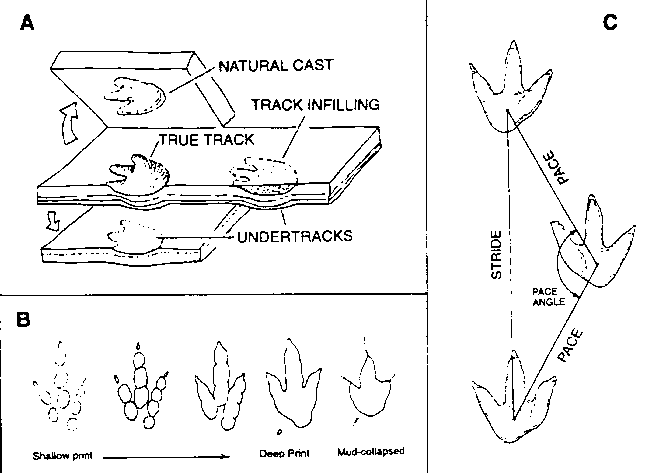
Figure 1.
A. Track Formation and Preservation
Diagram showing a true track, natural cast, undertracks, and track infilling as they might appear in rock strata. Adapted from Lockley (1991).
B. Track Variations Related to Sediment Consistency.
All the tracks shown were made by a single dinosaur stepping on substrates of different concistencies, with the firmer substrates at left and the softer ones on the right. Notice the absence of distinct pads in the deeper prints (at right). The right-most track suffers from "mud collapse" or "mud back-flow," where soft sediment slumps back into a track depression, distorting its shape. Adapted from Thulborn (1990).
C. Basic Trackway Measurements.
Pace angles (also called step angles or pace angulations) may be calculated useing trigonometry once pace and stride measurements are made. On a quadruped trackway, these measurements should be made for both rear and front prints. One should also measure individual print lengths, widths, depths, and digit dimenstions and angles.
(C) 1994, Glen J. Kuban
Return to Overview of Dinosaur Tracking article

Home Page |
Browse |
Search |
Feedback |
Links
The FAQ |
Must-Read Files |
Index |
Creationism |
Evolution |
Age of the Earth |
Flood Geology |
Catastrophism |
Debates